Implement AI Call Assistants: Boost Sales Efficiency Step-by-Step

Introduction
AI call assistants are reshaping business communication, providing a robust solution to enhance efficiency and customer engagement. By automating routine tasks and delivering real-time insights, these intelligent tools enable sales teams to concentrate on what truly matters: building relationships and closing deals. Yet, as technology evolves rapidly, businesses must consider how to effectively implement AI call assistants to maximize benefits and address potential challenges.
Define AI Call Assistants and Their Role in Business
AI call assistants are advanced software solutions that leverage artificial intelligence to enhance communication processes within businesses. These tools handle various tasks, such as responding to inquiries, qualifying leads, and providing real-time insights during discussions. By interpreting natural language effectively, AI communication tools understand client inquiries and respond accurately, ensuring that no lead is overlooked.
In today’s business landscape, the role of the AI call assistant is vital, as it streamlines operations and reduces the workload on human agents. This technology improves efficiency significantly by delivering timely and precise responses. Companies using AI call assistants report a boost in productivity, allowing sales teams to focus on building relationships instead of getting bogged down by routine tasks.
Recent advancements in AI communication tools have further improved their capabilities, enabling them to manage millions of conversations simultaneously and continuously enhance their performance through machine learning. Consequently, businesses can expect a notable increase in client satisfaction and engagement rates. In fact, studies show a rise in customer retention, reflecting a shift in expectations towards instant service.
Industry leaders stress the importance of integrating AI call assistants into their operations. Zach Grove, VP of Growth Marketing, notes that 92% of companies have adopted automation to some extent, highlighting a growing trend towards automation in client interactions. This shift not only enhances operational efficiency but also positions businesses to better meet the evolving needs of their clients.

Identify Key Benefits of Implementing an AI Call Assistant
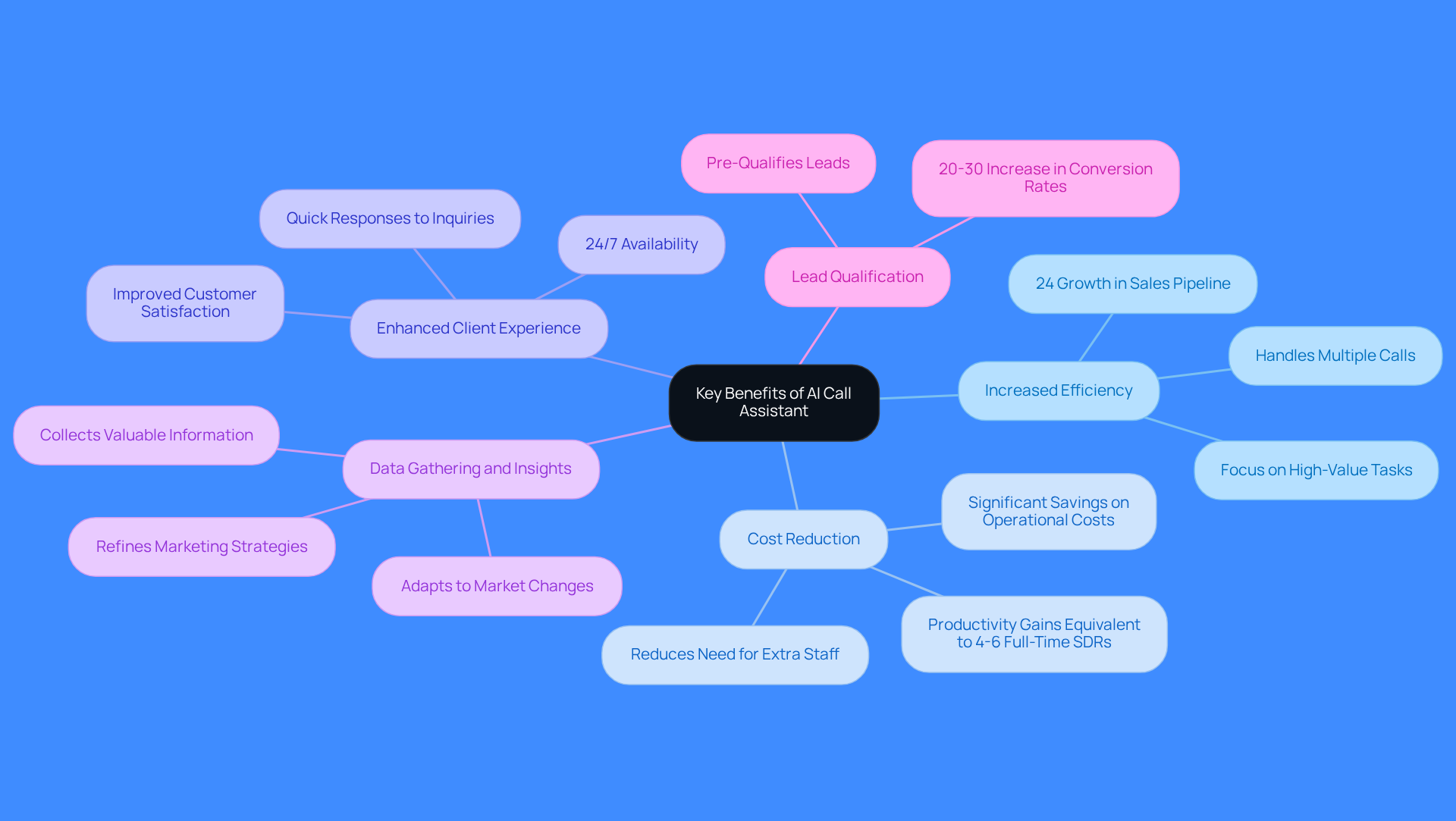
Implementing an AI Call Assistant addresses key operational challenges in modern outbound sales:
- Increased Efficiency: AI systems handle multiple calls at once, ensuring every customer inquiry is addressed. This capability boosts operational efficiency, allowing teams to focus on high-value tasks. For example, a B2B SaaS company using AI technology saw a significant increase in productivity, illustrating how AI enhances sales processes.
- Cost Reduction: Automating routine tasks reduces the need for extra staff, leading to lower operational costs. Regie.ai enabled a corporate performance management software provider to achieve substantial savings without increasing headcount. This efficiency results in significant savings, allowing teams to allocate resources more effectively.
- Enhanced Client Experience: With 24/7 availability, the AI assistant provides quick responses to inquiries, boosting satisfaction and engagement. Companies using AI solutions report notable improvements in response times, further enhancing the client experience.
- Data Gathering and Insights: These assistants collect valuable information during interactions, which can be analyzed to refine marketing strategies and improve client targeting. Regie.ai not only automates outreach but also delivers actionable insights that help teams adapt quickly to market changes and customer preferences.
The AI assistant can help streamline communication.
- Lead Qualification: The AI system pre-qualifies leads based on set criteria, ensuring representatives focus on high-potential prospects. This targeted approach, demonstrated by Regie.ai's clients, can lead to a higher conversion rate.
Together, these benefits contribute to increased sales efficiency, enabling teams to achieve higher conversion rates and build stronger customer relationships.
Outline the Step-by-Step Implementation Process
To effectively implement an AI call assistant, follow these structured steps:
- Define Objectives: Clearly outline the goals for the AI communication tool, such as increased efficiency. Specific objectives will guide your implementation strategy.
- Select Platform: Choose a platform for an AI call assistant that aligns with your business needs. Key factors include integration capabilities with existing systems, user-friendliness, and scalability for future growth. Research indicates that organizations selecting technology that fits their needs see a 25-30% reduction in implementation time. Look for a solution that integrates smoothly with your current marketing tools, ensuring a seamless transition.
- Design Pathways: Create intuitive conversational pathways for the AI. This involves scripting potential client inquiries and crafting suitable responses, ensuring smooth interactions that enhance user experience. The assistant can handle routine tasks, allowing your team to focus on meaningful conversations.
- Ensure Integration: Ensure the AI assistant integrates seamlessly with your CRM and other sales tools. This integration is essential for maintaining data consistency and optimizing workflow efficiency, as it can enhance productivity. Regie.ai's platform safeguards CRM integrity with clean, automatically synced data, providing a clear financial incentive for integration.
- Train the AI: Provide the AI with comprehensive training data to improve its understanding of client interactions. This may include historical communication data and common customer inquiries, crucial for enhancing response accuracy and relevance. The platform can assist in setting up agents tailored to your specific use case and business objectives.
- Test the System: Conduct thorough testing to identify potential issues or areas for improvement before full deployment. Simulating interactions and evaluating the AI's performance will ensure readiness and efficiency.
- Launch and Monitor: After successful testing, roll out the AI communication assistant. Continuously monitor its performance and gather user feedback to make necessary adjustments, ensuring the system adapts to evolving business needs. With Regie.ai, expect a collaborative approach to implementation that reduces administrative burdens while significantly improving efficiency.
By following these steps, companies can facilitate a smooth transition to AI call assistant systems, maximizing their potential to improve sales effectiveness and customer interactions. As Darren Gooding states, "AI is directly reshaping sales performance, lifting productivity by up to 40% and reducing sales cycles by a quarter."

Monitor and Evaluate Performance for Continuous Improvement
To maintain the effectiveness of your AI call assistant, implement a robust monitoring and evaluation strategy:
- Define specific metrics to measure the assistant's success, such as call resolution rates, customer satisfaction scores, and response times. High retention rates, like the average one-month retention at 39%, indicate user value and habit formation, showcasing the AI's effectiveness in meeting user needs.
- Analyze interaction data to identify trends, strengths, and weaknesses in the AI's performance. Monitoring conversation volume can reveal technical issues or user churn, ensuring the AI stays responsive to client demands.
- Gather feedback: Collect input from clients and sales representatives to understand their experiences and pinpoint areas for improvement. Engaging users is essential for addressing expectations, which can enhance satisfaction and retention.
- Adjust Conversational Flows: Refine conversational flows based on performance data and feedback to improve the AI's effectiveness in handling inquiries. This iterative process is crucial for adapting to changing client needs and ensuring optimal performance.
- Continuous Training: Regularly update the AI's training data with new user queries and scenarios to keep it relevant and effective. Continuous learning is vital for AI agents to adapt and thrive in dynamic environments.
- Invest in Monitoring Tools: Implement tools that provide real-time insights into the AI's performance. This proactive approach is key for effective management and helps identify areas for quick improvement.
- Benchmarking: Compare your AI support tool's performance against industry benchmarks to identify enhancement areas and set achievable goals. Understanding performance metrics, like response accuracy, offers valuable insights into the AI's impact on user experience.
By actively monitoring and evaluating the performance of the AI call assistant, businesses can ensure it continues to deliver value and adapt to evolving customer needs.

Conclusion
Implementing AI call assistants is a strategic move for businesses aiming to boost sales efficiency and customer engagement. By integrating these advanced tools, companies can streamline operations, cut response times, and enhance client satisfaction. AI in communication not only eases the workload for human agents but also positions organizations to meet the evolving demands of their customers more effectively.
This article highlights key benefits of AI call assistants:
- Increased efficiency through multitasking
- Cost savings by automating routine tasks
- Improved client experiences with immediate responses
It also underscores the significance of data collection for refining marketing strategies and enhancing lead qualification, which can lead to higher conversion rates. The provided implementation process serves as a practical guide for businesses ready to adopt this technology, ensuring they maximize its potential.
As AI reshapes sales and customer service, adopting these tools is crucial for maintaining a competitive edge. Organizations should not only implement AI call assistants but also continuously assess their performance. This proactive approach ensures businesses remain responsive to customer needs and can adapt to shifting market conditions, driving success in today’s fast-paced environment.
Frequently Asked Questions
What are AI call assistants?
AI call assistants are advanced software solutions that utilize artificial intelligence to improve communication processes within businesses. They handle tasks such as responding to inquiries, qualifying leads, and providing real-time insights during discussions.
How do AI call assistants benefit businesses?
They streamline operations, reduce the workload on human agents, boost efficiency, and enhance customer engagement by delivering timely and accurate responses. Companies using AI-driven solutions report a 37% reduction in first response times.
What impact do AI call assistants have on customer engagement?
AI call assistants significantly enhance customer engagement by ensuring that inquiries are addressed promptly and accurately, leading to increased client satisfaction. A majority of consumers (61%) prefer quicker replies from AI.
How have recent advancements in AI communication tools improved their capabilities?
Recent advancements have enabled AI communication tools to manage millions of conversations simultaneously and continuously improve their performance through machine learning.
What percentage of companies have adopted AI-driven solutions?
According to industry leaders, 92% of companies have adopted AI-driven solutions to some extent, indicating a growing trend towards automation in client interactions.
Why is it important for businesses to integrate AI call assistants into their sales strategies?
Integrating AI call assistants into sales strategies enhances operational efficiency and positions businesses to better meet the evolving needs of their clients, ultimately improving customer satisfaction and engagement rates.
List of Sources
- Define AI Call Assistants and Their Role in Business
- linkedin.com (https://linkedin.com/pulse/new-normal-67-businesses-now-using-ai-voice-agents-tvlxf)
- cnbc.com (https://cnbc.com/2026/01/29/how-ceos-bringing-ai-agents-to-work-are-preparing-customers-employees.html)
- 22 Top AI Statistics And Trends (https://forbes.com/advisor/business/ai-statistics)
- 50+ Conversational AI Statistics for 2026 (https://nextiva.com/blog/conversational-ai-statistics.html)
- 52 AI Customer Service Statistics You Should Know | Plivo (https://plivo.com/blog/ai-customer-service-statistics)
- Identify Key Benefits of Implementing an AI Call Assistant
- Top 10 AI Agents Transforming Sales and Customer Engagement in 2026 - Peterson Technology Partners (https://ptechpartners.com/2026/02/04/top-10-ai-agents-transforming-sales-and-customer-engagement-in-2026)
- AI in Sales 2025: Statistics, Trends & Generative AI Insights (https://cirrusinsight.com/blog/ai-in-sales)
- 75 statistics about AI in B2B sales and marketing (https://sopro.io/resources/blog/ai-sales-and-marketing-statistics)
- 50+ Conversational AI Statistics for 2026 (https://nextiva.com/blog/conversational-ai-statistics.html)
- 52 AI Customer Service Statistics You Should Know | Plivo (https://plivo.com/blog/ai-customer-service-statistics)
- Outline the Step-by-Step Implementation Process
- 37 Powerful Statistics That Prove AI Boosts Sales Efficiency| ROM (https://repordermanagement.com/blog/ai-boosts-sales-efficiency)
- AI in Sales 2025: Statistics, Trends & Generative AI Insights (https://cirrusinsight.com/blog/ai-in-sales)
- 75 statistics about AI in B2B sales and marketing (https://sopro.io/resources/blog/ai-sales-and-marketing-statistics)
- cubeo.ai (https://cubeo.ai/50-statistics-of-ai-in-sales-enablement)
- Monitor and Evaluate Performance for Continuous Improvement
- blog.workday.com (https://blog.workday.com/en-us/performance-driven-agent-setting-kpis-measuring-ai-effectiveness.html)
- pendo.io (https://pendo.io/essential-kpis-measuring-ai-agent-performance)
- AI contact center trends to watch in 2026: Transforming patient communication (https://healthcareitnews.com/news/ai-contact-center-trends-watch-2026-transforming-patient-communication)
FAQs
Read more posts
View all Blogs

Need more help?
If you still have questions, make sure to check out our Help Center: there, you'll find all the tips & advice you'll need to get your team up & running with Regie.ai.