B2B Tech Sales vs. Traditional Sales: Key Differences Explained

Introduction
Understanding the differences between B2B tech sales and traditional sales is crucial in today’s fast-paced market. B2B tech sales depend on complex technology solutions and data-driven strategies, while traditional sales often leans on personal relationships and face-to-face interactions. This article examines the key distinctions between these approaches, focusing on their unique characteristics, advantages, and challenges.
As businesses face these realities, the pressing question is: how can sales professionals adjust their strategies to excel in these contrasting environments?
Define B2B Tech Sales and Traditional Sales
B2B Tech Sales involve selling tech products or services between companies and often feature software, hardware, or cloud services. This model requires a deep understanding of technology and the ability to tackle complex challenges.
In contrast, Traditional Sales covers a wider array of practices, primarily centered on tangible products or services. It relies heavily on personal connections and face-to-face interactions, utilizing methods such as:
- Direct marketing
- Telemarketing
- Retail transactions
The focus in Traditional Sales is on relationship building, which is essential for closing deals.
As the market evolves, understanding the differences between these two approaches becomes critical, especially since B2B buyers now conduct 69% of their purchasing process independently before engaging with sales representatives.

Compare Key Characteristics of B2B Tech Sales and Traditional Sales
faces a significant challenge: its reliance on technology and data-driven decision-making often results in lengthy transaction cycles due to product complexity. Sales teams must also engage effectively with various stakeholders within client organizations, navigating complex decision-making processes.
In contrast, Traditional Commerce prioritizes relationship building and typically features personal connections, focusing on trust built through direct interactions. While this approach can lead to quicker transactions, it often lacks the depth of engagement that tech marketing demands.
Moreover, B2B tech sales leverages advanced tools to track customer interactions meticulously and refine outreach strategies. Traditional commerce, however, often depends on manual processes and personal networks, which can hinder scalability and efficiency.
As the commercial landscape evolves, the shift into B2B tech sales is becoming essential. This integration allows teams to utilize technology effectively, enabling small teams to effectively target large markets with personalized, signal-driven outreach that sales representatives simply cannot manage manually.
This transition underscores the need for professionals in commerce to evolve from mere presenters to trusted consultants who provide strategic guidance.

Evaluate Pros and Cons of B2B Tech Sales vs. Traditional Sales
faces significant operational challenges due to inefficiencies. These inefficiencies can slow down processes and hinder revenue growth. By integrating technology effectively, sales teams can enhance efficiency, scalability, and data-driven insights. Technology allows commercial teams to focus on high-value activities like relationship building and strategic planning.
For instance, organizations using technology tools have seen a 48% positive email response rate and a 24% increase in their sales conversions. This showcases how technology can streamline communication, enabling teams to create tailored messages quickly, thus reducing time spent on manual processes.
However, the complexity of technology transactions often leads to misunderstandings and necessitates extensive training for sales representatives. Nearly 50% of B2B purchasers cite security as their top concern after pricing, highlighting the challenges tech vendors face in addressing buyer apprehensions. In contrast, Traditional Commerce excels in personal interactions, which can result in faster sales closures. Yet, it struggles with scalability and efficiency, particularly in larger markets where technological advancements can significantly improve outreach.
Moreover, Traditional Sales may falter in adapting to rapidly changing market conditions. B2B Tech Sales provides a more agile framework, on the other hand. As market dynamics shift, the ability to leverage technology tools for immediate insights and automated processes becomes increasingly critical. Lauri Kurki emphasizes that effective communication and ensuring clarity in transaction processes are essential for success. The success stories from Regie.ai further demonstrate how leveraging innovations can effectively navigate the complexities of modern sales environments.

Assess the Role of Technology in B2B Tech Sales and Traditional Sales
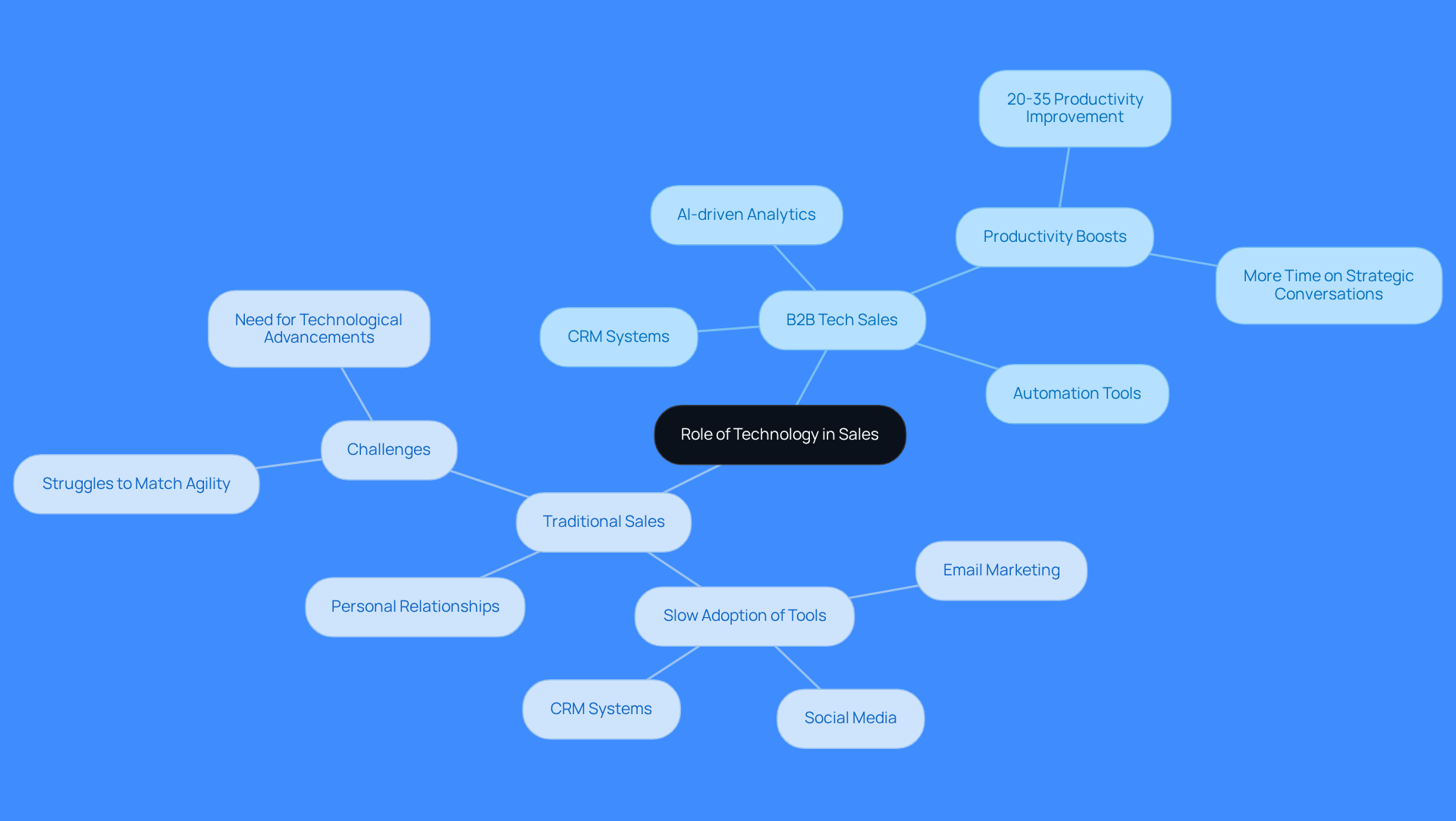
In the realm of sales, technology is crucial for streamlining processes and enhancing efficiency. Business teams utilize advanced software, analytics, and automation tools to sharpen their outreach and follow-up strategies. This integration fosters personalized and timely interactions with potential clients, leading to improved engagement rates. Organizations using AI sales tools report increased productivity, enabling teams to concentrate on strategic customer conversations instead of administrative tasks.
Conversely, Traditional Commerce has relied heavily on personal relationships and face-to-face interactions. While it is gradually adopting tools like email marketing, social media, and CRM systems for lead generation and customer communication, the pace of this adoption is slower and less comprehensive. As a result, Traditional Commerce struggles to match the agility and responsiveness of B2B Tech Sales, where technology plays a crucial role in the strategy. This gap underscores the necessity for businesses to innovate to stay competitive in a rapidly evolving marketplace.
Conclusion
Understanding the differences between B2B tech sales and traditional sales is crucial for navigating today’s commercial landscape. B2B tech sales revolve around complex tech solutions, demanding a solid grasp of technology and data-driven decision-making. In contrast, traditional sales prioritize personal relationships and direct interactions. This distinction underscores the necessity for sales professionals to tailor their strategies to meet the unique demands of each model.
B2B tech sales often encounter longer transaction cycles and operational hurdles, requiring advanced tools and a consultative approach to engage clients effectively. Traditional sales, on the other hand, benefit from quicker cycles and strong rapport but may struggle with scalability and adaptability. The integration of technology in B2B tech sales boosts efficiency and fosters personalized customer engagement, highlighting the need to embrace innovation in both sales approaches.
As the marketplace evolves, it’s vital for sales professionals to recognize and adapt to these differences. By embracing technology and refining engagement strategies, they can enhance productivity and maintain competitiveness in a landscape where customer expectations and market dynamics are in constant flux. The path to successful sales in either model lies in understanding these nuances and leveraging the right tools to tackle the unique challenges each approach presents.
Frequently Asked Questions
What is B2B tech sales?
B2B tech sales involve selling technology products or services between companies, often featuring complex solutions like software, hardware, or cloud services. This sales model requires a deep understanding of technology and the ability to address specific business challenges.
How does B2B tech sales differ from traditional sales?
Traditional sales, or Traditional Commerce, encompasses a broader range of practices focused primarily on tangible products or services. It relies heavily on personal connections and face-to-face interactions, utilizing methods such as direct marketing, telemarketing, and retail transactions.
What is the primary focus of traditional sales?
The primary focus of traditional sales is on building rapport and trust with customers, which is essential for closing deals.
Why is it important to understand the distinction between B2B tech sales and traditional sales?
Understanding the distinction is critical as the market evolves, especially since B2B buyers now conduct 69% of their purchasing process independently before engaging with sales representatives.
List of Sources
- Define B2B Tech Sales and Traditional Sales
- pipeline.zoominfo.com (https://pipeline.zoominfo.com/sales/what-is-b2b-sales)
- groweon.com (https://groweon.com/blog/what-is-sales-in-2026)
- What Is B2B Sales? Modern Strategies for 2026 | Apollo (https://apollo.io/insights/b2b-sales)
- linkedin.com (https://linkedin.com/pulse/b2b-sales-2026-what-expect-kristian-rasmussen-5h64e)
- The 2026 Sales Reckoning: Why Your Traditional Sales Team Is About To Look Very Different (https://saastr.com/the-2026-sales-reckoning-why-your-traditional-sales-team-is-about-to-look-very-different)
- Compare Key Characteristics of B2B Tech Sales and Traditional Sales
- The Future of Selling in 2026: 13 Trends That Will Reshape Sales Teams (https://mtdsalestraining.com/mtdblog/future-of-selling-2026)
- outreach.io (https://outreach.io/resources/blog/sales-trends)
- The 2026 Sales Reckoning: Why Your Traditional Sales Team Is About To Look Very Different (https://saastr.com/the-2026-sales-reckoning-why-your-traditional-sales-team-is-about-to-look-very-different)
- What Is B2B Sales? Modern Strategies for 2026 | Apollo (https://apollo.io/insights/b2b-sales)
- linkedin.com (https://linkedin.com/pulse/5-predictions-reshape-b2b-2026-onlyb2b-cuh1f)
- Evaluate Pros and Cons of B2B Tech Sales vs. Traditional Sales
- The 2026 Sales Reckoning: Why Your Traditional Sales Team Is About To Look Very Different (https://saastr.com/the-2026-sales-reckoning-why-your-traditional-sales-team-is-about-to-look-very-different)
- leadfeeder.com (https://leadfeeder.com/blog/b2b-marketing-guide-for-technology-companies)
- B2B Sales Trends 2026: Key Insights & Strategies - Qobra (https://qobra.co/blog/b2b-sales-trends-2026)
- 180ops.com (https://180ops.com/blog/b2b-sales-in-2026-the-7-strategic-shifts-reshaping-revenue)
- Assess the Role of Technology in B2B Tech Sales and Traditional Sales
- 15 sales technology trends that will impact GTM in 2026 (https://highspot.com/blog/sales-technology-trends)
- Sales in 2026: Will AI Take Your Job or Make You Better at It? (https://marketsandmarkets.com/blog/ICT/ai-sales-in-2026)
- salesforceeurope.com (https://salesforceeurope.com/blog/how-ai-changes-the-way-tech-is-sold-in-2026)
- linkedin.com (https://linkedin.com/pulse/2026-sales-tech-stack-3-ai-tools-reshaping-b2b-william-nii-sarkwah-aawzf)
- trykondo.com (https://trykondo.com/blog/b2b-sales-benchmarks-2025)
FAQs
Read more posts
View all Blogs

Need more help?
If you still have questions, make sure to check out our Help Center: there, you'll find all the tips & advice you'll need to get your team up & running with Regie.ai.