AI-Driven Sales Strategies
AI SDR: The Complete Guide to AI Sales Development in 2026
The Regie Team
|
Apr 15, 2026
You've probably seen the pitch a dozen times by now. "Hire an AI SDR. Replace your reps. Book meetings on autopilot." It sounds great in a demo. Then you deploy it, and three months later you're staring at burned domains, confused prospects, and a tool that's already half-abandoned by your team.
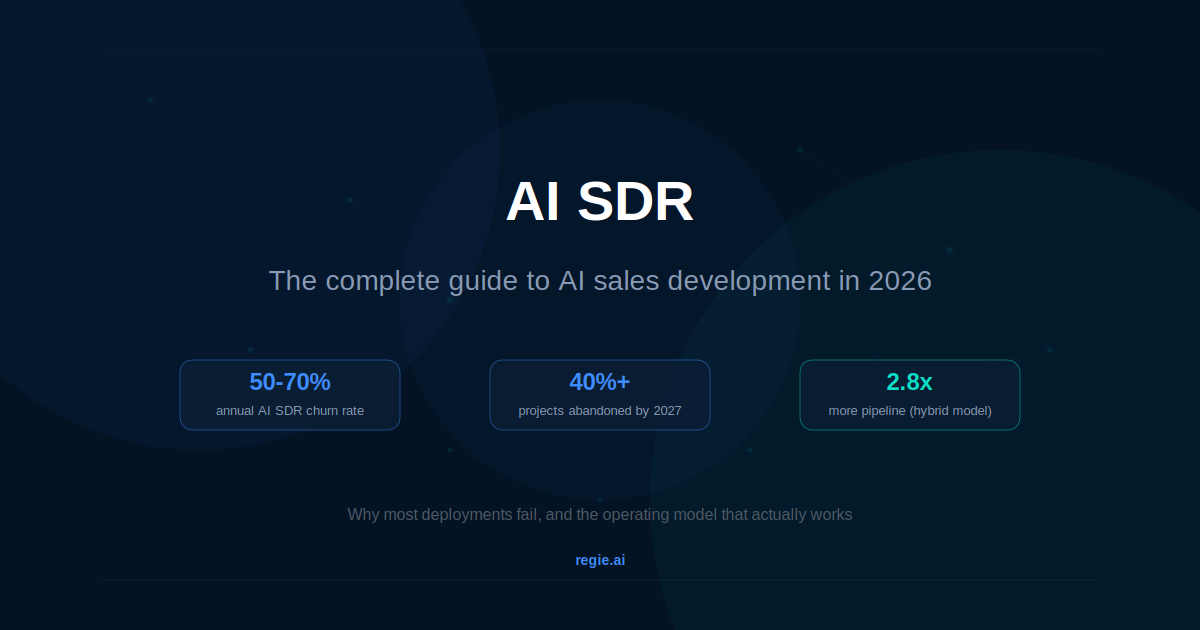
You're not alone. AI SDR tools churn at 50-70% annually, according to UserGems' 2026 data. And Gartner predicts that over 40% of agentic AI projects will be abandoned by the end of 2027. The AI SDR market is worth $5.2 billion in 2026 and growing fast. But most of that money is being spent on tools that don't stick.
So what's going wrong? And more importantly, what does an AI SDR deployment look like when it actually works?
That's what this guide covers. Not a ranking of tools. Not a listicle. A real breakdown of what AI SDRs are, why most deployments fail, and what operating model separates the teams generating 2.8x more pipeline from the ones cycling through their third tool in 18 months.
What Is an AI SDR?
An AI SDR (AI Sales Development Representative) is software that automates the tasks a human SDR typically handles: finding prospects, researching accounts, writing outreach, sending emails and LinkedIn messages, following up, and booking meetings.
The concept is straightforward. Instead of a human spending 2-3 minutes per personalized email (or worse, blasting the same template to 500 people), an AI agent handles that work autonomously. It pulls from your CRM data, enrichment sources, and buying signals to decide who to contact, what to say, and when to reach out.
But here's where most buyers get tripped up. The term "AI SDR" gets applied to wildly different products:
Sequence automators take your existing email templates and send them on a schedule with basic personalization (first name, company name). Not much AI happening. Just faster mail merge.
AI writing assistants help reps draft better emails but don't send anything autonomously. The human still runs the workflow.
Autonomous AI agents handle the full loop: sourcing prospects, researching context, generating personalized messages, executing multi-channel outreach, handling replies, and routing warm leads to human reps. The human configures the system and takes the meetings. The AI does everything in between.
AI-native platforms go one step further. Instead of adding an AI agent on top of your existing tools (your SEP, your dialer, your enrichment provider), they replace the entire stack with a unified system where AI agents and human reps work in one workflow.
That last distinction matters more than most people realize. And it's the main reason deployment outcomes vary so dramatically.
How AI SDRs Actually Work
Underneath the marketing, AI SDRs run on a few core capabilities. Understanding these helps you evaluate what you're actually buying.
Signal ingestion. The AI monitors buying signals: website visits, content downloads, job changes, funding announcements, technology installs, email engagement, ad clicks. Better AI SDRs ingest signals from multiple sources (first-party, second-party, third-party) and use them to prioritize who gets contacted and when. Regie's AI agents, for example, monitor 100+ built-in signals and act on them in real time, not in a weekly report that sits in a dashboard.
Prospect discovery and enrichment. Rather than waiting for a human to build a list, AI agents source ICP-fit contacts from built-in databases, verify their information, and enrich records with context the outreach engine needs. The difference between tools here is huge. Some require you to import lists. Others discover net-new prospects autonomously. Regie calls this Audience Expansion, where AI agents find lookalike or ABM prospects without human list-building.
Message generation. Natural language models write personalized outreach based on prospect context, not just {first_name} tokens. The best systems reference real triggers (a recent funding round, a job change, a pricing page visit) to make messages feel relevant. But quality varies enormously. Generic AI copy is easy to spot and easy to ignore.
Multi-channel orchestration. Email alone doesn't cut it anymore. AI SDRs that cover email, phone, and LinkedIn in a coordinated workflow outperform single-channel tools by a wide margin. Martal Group's research shows multi-channel outreach generates 250% higher conversion than single-channel.
Dynamic sequencing. Old-school outreach runs on static cadences: Day 1 email, Day 3 call, Day 7 follow-up. It doesn't matter what the prospect does in between. Signal-driven outreach works differently. If a prospect visits your pricing page, their score updates, messaging shifts, and they move to the top of the call queue. Hours, not days.
CRM integration. Every interaction gets logged automatically. Activity data, engagement signals, and qualification notes flow back to Salesforce or HubSpot without reps doing manual data entry. For RevOps leaders, this is the difference between a clean pipeline and a CRM full of gaps.
Why Most AI SDR Deployments Fail
Here's the part nobody talks about in their product demo.
The 50-70% annual churn rate for AI SDR tools isn't a bug in one specific product. It's a pattern across the category. And Gartner's prediction that 40%+ of agentic AI projects will be abandoned by 2027 suggests the problem is structural, not just a matter of picking the wrong vendor.
Three root causes explain most failures:
1. Bolting AI onto a broken workflow. Most companies buy an AI SDR and drop it into their existing process. The rep's day doesn't change. The tech stack doesn't change. The AI just sends more emails faster through the same disconnected tools. The result? Higher volume of the same mediocre outreach, now with deliverability problems because you're blasting from burned domains.
The fundamental issue: the workflow was designed for humans, not for AI-human collaboration. Adding AI to a human-centric workflow is like putting a jet engine on a bicycle. The frame wasn't built for it.
2. Treating AI as a headcount replacement instead of an operating model shift. The "replace your SDR" pitch is seductive. One AI agent costs $900/month. One human SDR costs $120,000-$180,000/year fully loaded (that's salary, benefits, tools, management overhead, and replacement costs when they leave after 18 months). The math seems obvious.
But companies that use AI to fully replace human SDRs see worse results than those that use it to augment them. The data is clear: teams running a hybrid model (AI handles upstream prospecting, humans handle conversations) generate 2.8x more pipeline than teams attempting full replacement. Why? Because AI is great at research, personalization, and timing. It's not great at reading emotional cues, handling objections in real time, or building the trust that closes complex B2B deals.
3. Point solution fragmentation. Here's a scenario RevOps leaders know too well. You buy an AI SDR tool. But it doesn't include a dialer, so you keep Nooks. It doesn't handle enrichment, so you keep Clay. It doesn't manage deliverability, so you add a warmup tool. It doesn't track intent, so you keep your 6sense subscription. Now you have six tools that don't natively talk to each other, data flowing through Zapier integrations that break every quarter, and an AI SDR that's only as good as the fragmented data it can access.
The tool isn't the problem. The architecture is.
The Force Multiplier Rep: A Different Operating Model
What if the question isn't "which AI SDR should I buy?" but "what operating model do I actually need?"
That's the premise behind the Force Multiplier Rep, an operating model where AI agents handle all upstream prospecting work (sourcing, enrichment, research, messaging, scheduling) and human reps focus 100% on live conversations. Not replacement. Redistribution.
As Regie.ai co-founder Matt Millen puts it: "Sales didn't stall because reps stopped working hard. It stalled because the operating model stopped scaling."
Here's what the Force Multiplier Rep's day actually looks like:
Morning: The rep opens one platform (not six). AI agents have been working overnight: sourcing new ICP contacts, enriching records, sending personalized outreach across email and LinkedIn, monitoring signals, and routing warm prospects into a prioritized call queue. The rep sees a ranked list of who to call first, why, and what to say.
Midday: The rep runs a call block using a built-in parallel dialer. AI generates personalized call scripts and drops voicemails in the rep's actual voice for prospects who don't pick up. Between calls, the rep handles warm email replies that the AI agent has flagged as ready for a human touch. No tab-switching. No copy-pasting between tools.
Afternoon: The rep takes discovery calls that the AI agents booked. CRM updates happen automatically. AI scorecards evaluate the call against custom criteria. The manager reviews coaching opportunities on the Salesfloor without sitting in on every call.
Notice what's missing from that day: list building, data entry, email drafting, sequence management, CRM cleanup, tool administration. All of it handled by AI. That's not a 10% productivity improvement. It's a structural redesign of the role.
Regie runs this model internally. The results, published as a case study: AI Agents now contribute to over 40% of all SDR-driven meetings. Auto-Pilot sourced 26,000 new leads and 800+ accounts not previously in CRM. Prospect volume per rep jumped from 25 to 60-100 per day. And the team projects 1,000 hours per year saved from auto-sourcing alone.
One rep with this model covers what used to take 3-5 reps with a legacy stack.
AI SDR vs. Human SDR: The Real Comparison
The "AI vs. human" framing is misleading. It implies you need to pick one. The data says you shouldn't.
The cost comparison is worth unpacking. A fully loaded SDR (salary, benefits, tools, management overhead, replacement costs) runs $120,000-$180,000 per year, according to Bridge Group, demandDrive, and Konsyg analyses. AI SDR tools range from $12,000 to $60,000 per year. But the comparison that matters most isn't AI vs. human. It's AI-as-replacement vs. AI-as-augmentation.
SDRs spend only 28% of their time actually selling. The other 72% goes to research, data entry, email drafting, and CRM updates. An AI-native platform doesn't replace the 28%. It eliminates the 72%. Your rep's selling time doesn't double. It triples.
There's another cost most people forget: turnover. SDR attrition runs 30-50% annually. Every time someone leaves, you're back to recruiting (60-90 days), onboarding (30 days), and ramp (60-90 days). That's 5-6 months of lost productivity per departure. An AI agent doesn't quit after 14 months to become an AE at a competitor. It doesn't need ramp time. It runs the same quality at month 12 as month 1.
But the strongest argument for the hybrid model isn't cost savings. It's pipeline quality. When AI handles the volume work and humans handle the judgment work, you get both reach and relevance. AI-led outreach converts at 14.2% when fully personalized, compared to 3% for human-only outreach, according to AiSDR's 2026 Industry Report. Pair that conversion rate with human reps running discovery calls, and you've built a pipeline engine that scales without sacrificing deal quality.
87% of sales organizations now use some form of AI (Salesforce State of Sales, 2026). The remaining question is how deep the integration goes. A copilot that helps reps write better emails is a 10% improvement. An AI-native platform that restructures the entire workflow is a 3-5x multiplier.
The Hidden Cost Nobody Talks About: Your Tool Stack
Quick exercise. Add up what your sales team pays for:
- Sales engagement platform (Outreach, SalesLoft): $100-180/user/month
- Parallel dialer (Nooks, Orum): $50-100/user/month
- Data enrichment (Clay, ZoomInfo): $100-300/month
- Intent data (6sense, Bombora): $1,000-3,000/month
- Email deliverability (warmup, inbox rotation): $50-100/month
- Research tools (LinkedIn Sales Nav, etc.): $80-100/user/month
For a 10-rep team, that's $150,000-$400,000+ per year in tool costs alone. Before salaries. And none of those tools talk to each other natively. Data flows through brittle integrations. Signals get lost between systems. Your RevOps team spends half their week keeping the plumbing running.
Compare that to an AI-native platform that replaces the entire stack: SEP, dialer, enrichment, intent signals, deliverability, and AI agents in one system. Everything connected by design. One login. One data layer. One workflow.
That's the stack consolidation argument that no standalone AI SDR can make. Because they're another point solution on the pile.
Regie.ai president Matt Millen has been direct about this: "You don't need more tools. You need fewer, better-connected ones." RegieOne was built specifically to replace the 5-7 disconnected tools that make up the typical outbound stack, with a single AI-native platform that includes 220 million+ contacts, a built-in dialer, and the only patented AI agent technology for dynamic next-best-action decisioning.
How to Evaluate an AI SDR Platform
If you're evaluating AI SDR options, here are the questions that actually predict long-term success (not just a good demo).
Does it act on signals, or just send on a schedule? Static day-by-day cadences are the legacy approach. The bar in 2026 is real-time signal response: a prospect visits your pricing page, and outreach adjusts within hours. Ask the vendor how their system handles buying signal ingestion and prioritization.
Does it replace your stack, or add to it? Every tool you keep is another integration to maintain, another data silo, another login for your reps. Ask whether the platform includes enrichment, dialing, deliverability, and intent data natively, or if you need to buy those separately.
Can AI and human reps share one workflow? Most AI SDR tools create a parallel workflow. The AI does its thing over here, the rep does their thing over there, and someone has to merge the two. Ask how AI tasks and human tasks are orchestrated together. Is there one queue, or two?
What happens when the AI doesn't know what to do? Every AI hits edge cases. The question is whether it fails silently (drops the lead) or escalates gracefully (routes to a human with context). Ask about handoff logic and what the rep sees when a lead gets escalated.
Where's the proprietary data? A patented AI architecture means the vendor has invested in foundational R&D, not just wrapped an API around a language model. Ask about patents, proprietary models, and what they've built that competitors can't copy. Regie, for example, holds a US patent on dynamic next-best-action AI agents, granted October 2025.
What does the data say about churn? If a vendor won't share retention data, that tells you something. The industry average is ugly (50-70% annual churn). The good vendors will show you customer tenure, expansion rates, and testimonials from teams that have been using the product for 12+ months.
AI SDR Tools: How the Market Breaks Down
The AI SDR market in 2026 isn't a single category. It's four distinct segments:
AI-native platforms replace the entire sales engagement stack with a unified system. Regie.ai (RegieOne) is the clearest example. Built from scratch as an AI-native sales engagement platform, not AI bolted onto a legacy SEP. Includes prospecting agents, parallel dialer, enrichment, intent signals, and deliverability in one workflow. Starting at $35,000/year. Best for mid-market and enterprise teams that want to consolidate their stack and run the Force Multiplier Rep model.
Standalone AI SDR agents focus on autonomous outbound execution. 11x.ai (Alice), Artisan (Ava), and AiSDR are the most prominent. They handle prospect research, email writing, and follow-up autonomously. Pricing ranges from $900/month (AiSDR) to $5,000+/month (11x). Best for teams that want AI to run outbound independently. The tradeoff: you still need a separate dialer, SEP, and enrichment tool.
Legacy SEPs adding AI features. Outreach and SalesLoft (now part of Clari) have added AI capabilities on top of their existing sequence-based architecture. The AI helps reps write better emails and suggests next steps. But the core workflow is still a human building a static cadence and manually adding prospects. It's AI-assisted, not AI-native. And the pricing hasn't gotten cheaper as they've added features.
Enrichment-first tools. Clay is the best known. Extraordinary for data enrichment and research workflows. But it can't send a single email, make a phone call, or run a sequence. It's a data layer, not an AI SDR. Powerful when paired with execution tools, but not a replacement for them.
The choice depends on your GTM motion, team size, and how much operational complexity you want to manage. For teams that want one platform instead of five, the AI-native approach eliminates the integration tax that drags down point-solution stacks.
Getting Started with AI SDRs
If you're deploying AI into your sales development workflow for the first time, a few principles save months of frustration:
Start with your ICP, not the tool. Before configuring any AI SDR, get your ideal customer profile airtight. Firmographic criteria, persona definitions, deal-stage indicators, and disqualification rules. AI amplifies whatever you feed it. If your ICP is fuzzy, the AI will prospect fuzzy accounts at massive scale. That's worse than doing nothing.
Clean your data first. An AI SDR connected to a CRM full of duplicates, outdated contacts, and missing fields will produce garbage outreach. Spend a week on data hygiene before you flip the switch. Deduplicate records. Verify email addresses. Fill in missing job titles. The AI can maintain data quality going forward, but it needs a clean starting point.
Run a pilot, not a rollout. Pick one segment, one persona, one use case. Let the AI run for 30-60 days. Measure meetings booked, positive reply rate, and pipeline created. Don't judge on email volume or open rates. Those are vanity metrics that don't predict revenue. Judge on business outcomes.
Expect 30-60 days to see results. Most AI SDR platforms show initial signals in 2-4 weeks and meaningful pipeline in 60-90 days. If you're 90 days in and seeing nothing, either the tool isn't working or (more likely) the configuration needs adjustment. The strongest sales teams report 317% annual ROI with a 5.2-month payback period, according to Valley's 2026 analysis. But those are teams with clean data and sharp targeting. Teams with poor data hygiene may take 6-9 months or churn before reaching ROI.
Keep humans in the loop for high-value conversations. AI books the meeting. A human runs the discovery call. AI handles the follow-up sequence. A human negotiates the deal. The Force Multiplier Rep model works because it plays to each side's strengths. Trying to remove humans from the conversation entirely is how you end up in the 50-70% churn bucket.
Audit your stack before adding another tool. If you're already paying for an SEP, a dialer, an enrichment tool, an intent provider, and a deliverability tool, don't add an AI SDR as tool number six. Evaluate whether an AI-native platform can replace several of them at once. The consolidation savings often cover the cost of the new platform entirely.
Watch your domain reputation. AI can send volume fast. That's a feature and a risk. If the system is blasting thousands of generic emails from your primary domain, your deliverability will crater within weeks. Make sure whatever platform you use has built-in domain rotation, warmup protocols, and send throttling. Monitor inbox placement rates weekly during the first 90 days.