B2B Sales Funnel vs. B2C: Key Differences and Best Practices
Introduction
B2B sales often struggle with complex decision-making and multiple stakeholders, leading to inefficiencies that hinder conversion rates. While B2B transactions require careful navigation, B2C sales prioritize speed and emotional engagement. Identifying the key differences and best practices for each funnel type can enhance conversion rates and streamline operations. Sales teams must adopt tailored strategies to navigate these complexities and drive measurable results.
Define B2B and B2C Sales Funnels: Core Concepts and Structures
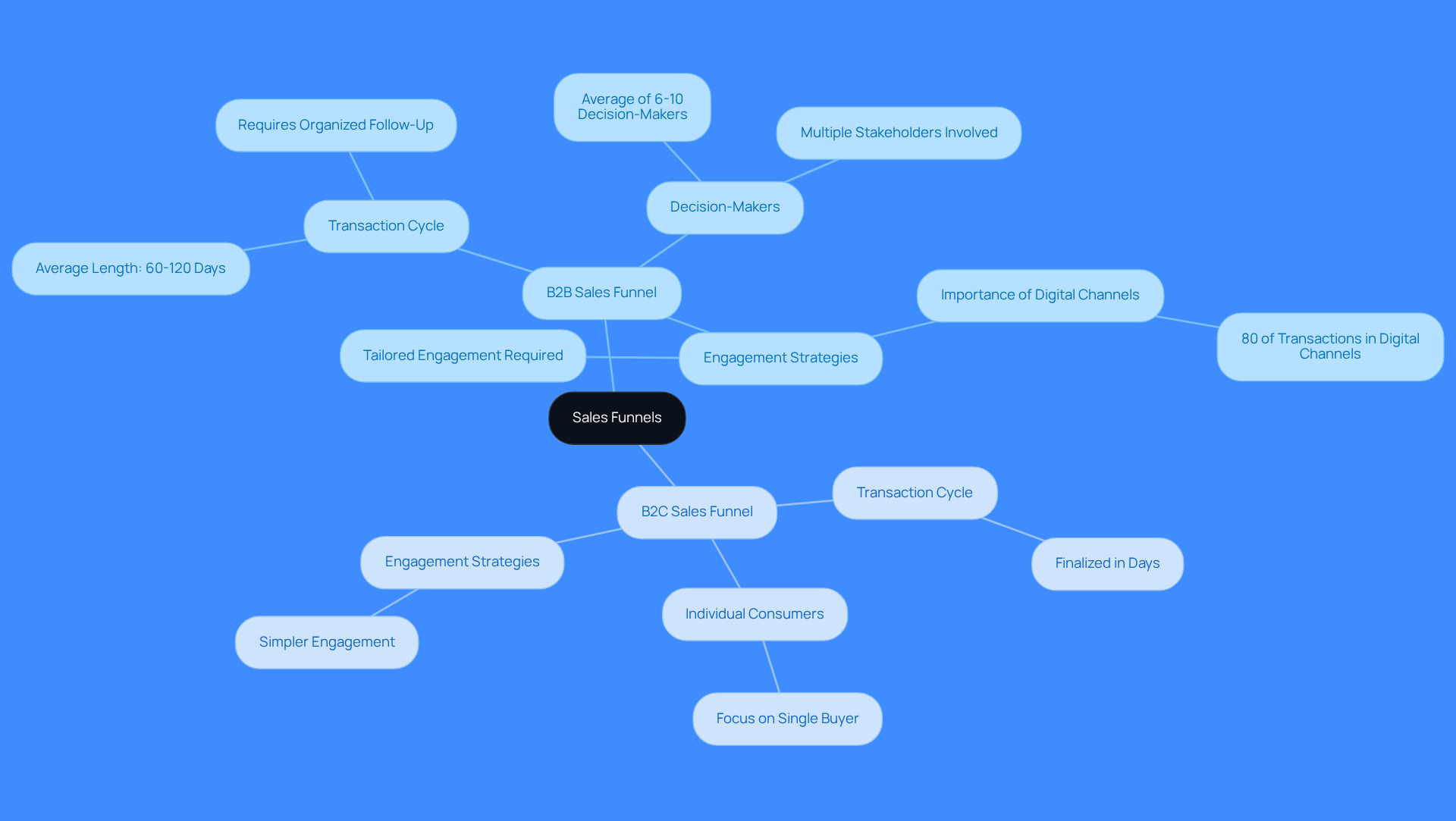
B2B sales processes are often bogged down by lengthy transaction cycles and multiple decision-makers, creating significant operational challenges. These sales funnel B2B involve multiple stakeholders, which complicates the sales process and requires tailored engagement strategies. The average B2B transaction cycle spans 60 to 120 days, often requiring organized follow-up to maintain momentum.
In contrast, B2C purchasing is more straightforward, focusing on individual consumers. B2C processes can finalize transactions in days, while B2B pathways may require months due to the involvement of several decision-makers.
Understanding these differences is essential for sales teams to effectively tailor their strategies and messaging in the sales funnel B2B. The distinction between B2B and B2C pathways underscores the need for varied approaches in managing customer relationships and improving conversion rates in the sales funnel B2B. With 80% of B2B transactions occurring in digital channels, effective online engagement is crucial. Responding to leads within 5 minutes makes prospects 9 times more likely to convert, emphasizing the importance of prompt follow-up in B2B sales. With Regie.ai's AI-driven signals and integrated parallel dialing feature, representatives can enhance their outreach efficiency, ensuring they connect with leads at the right moment with the appropriate message.
Compare Stages of B2B and B2C Sales Funnels: Awareness to Conversion
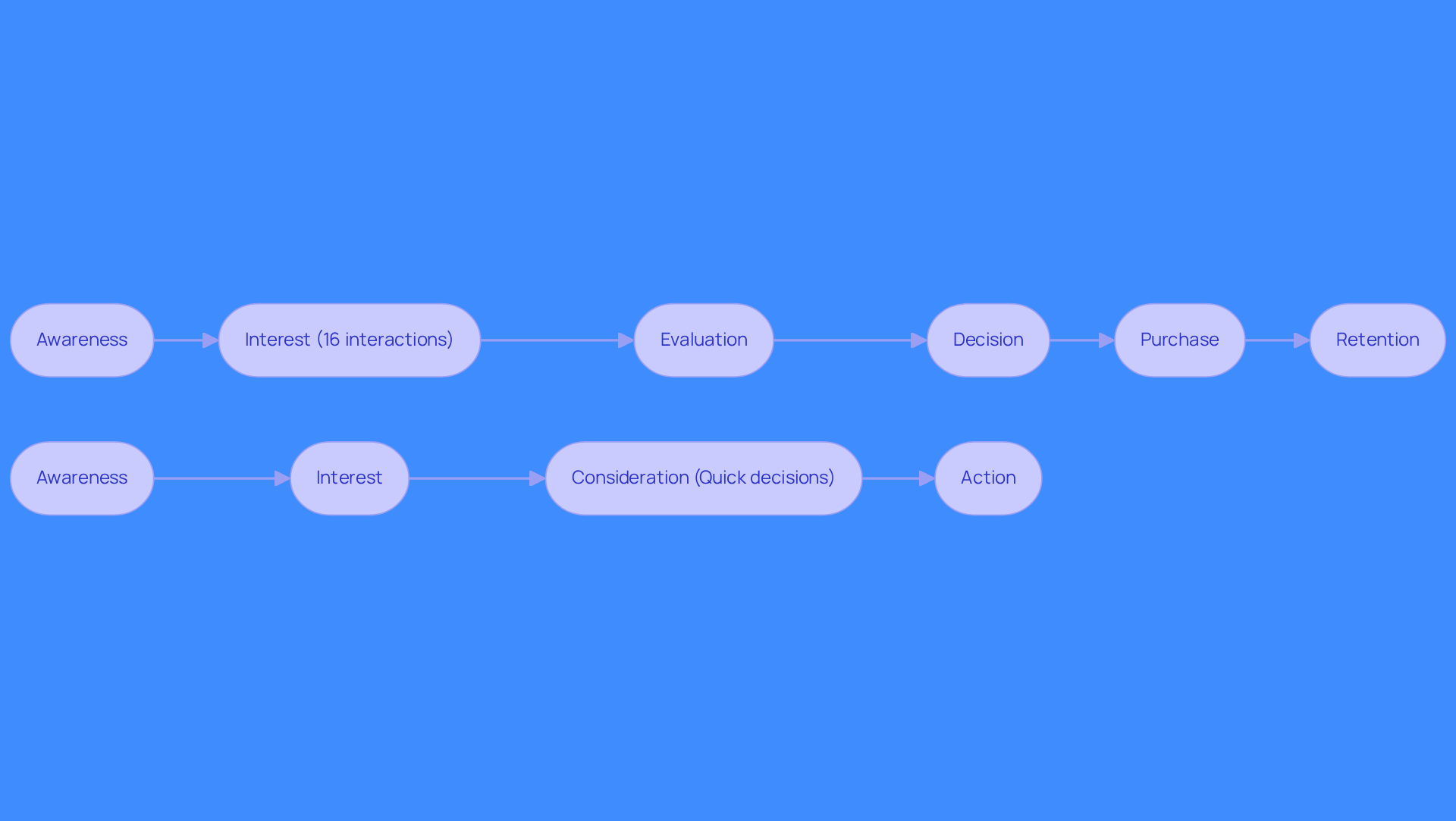
The complexity often bogs down B2B sales processes, necessitating a tailored approach at every stage of the sales funnel B2B. The B2B sales process includes six stages:
- Awareness
- Interest
- Evaluation
- Decision
- Purchase
- Retention
Each stage necessitates comprehensive information and collaboration among multiple stakeholders, which can significantly extend the decision-making timeline. For instance, B2B buyers average 16 interactions with the winning vendor, underscoring the intricate nature of their purchasing journey.
B2C processes are more streamlined, focusing on speed and emotional connection. The B2C purchasing process typically comprises four stages:
- Awareness
- Interest
- Consideration
- Action
Consumers often make quicker decisions driven by immediate needs, with transaction cycles lasting only hours or days, unlike the months or years common in B2B.
While both funnels aim to convert leads, the sales funnel B2B demands deeper engagement strategies due to its complexity. In contrast, B2C emphasizes speed and emotional connection, reflecting the differing priorities and behaviors of their respective audiences.
In this context, Regie.ai's capabilities come into play. Its AI-driven automation enhances engagement by creating personalized messaging across email, LinkedIn, and calls, ensuring outreach is tailored to each lead's distinct needs. Moreover, Regie.ai's dynamic workflows enable teams to balance competing priorities effectively, enhancing customer retention and driving growth while ramping up outbound efforts. With features like parallel dialing, which boosts talk time by connecting representatives to several leads simultaneously, and the ability to use over 100 signals to prioritize leads based on genuine buying intent, Regie.ai empowers teams to manage the intricacies of B2B transactions. This strategic approach is essential for addressing the urgent need for pipeline generation amidst declining inbound leads and inconsistent outbound results.
Implement Best Practices for B2B and B2C Sales Funnels: Strategies for Success
B2B sales funnel often struggle with inefficiencies that hinder conversion rates.
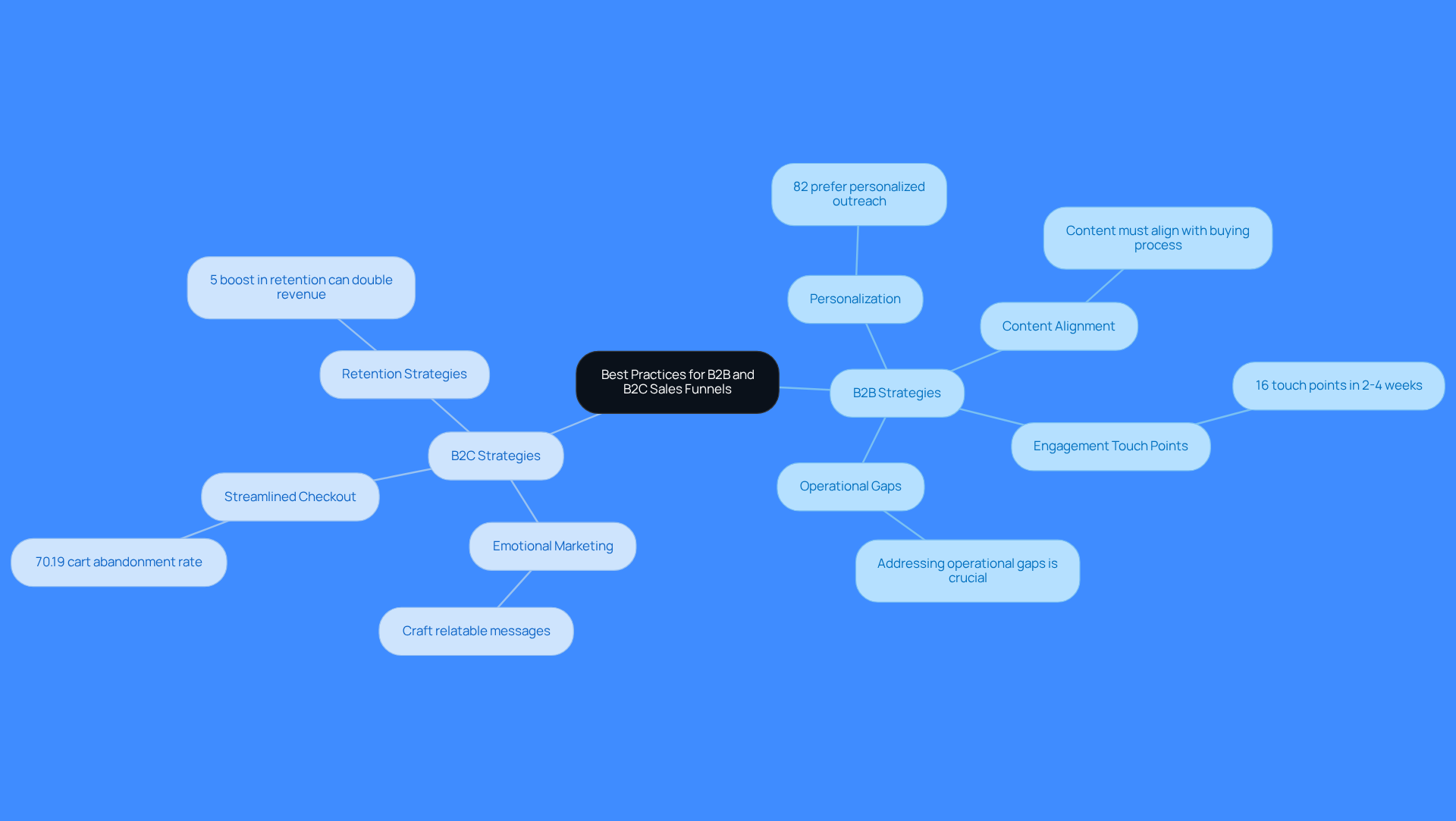
- Personalization is key. 82% of buyers prefer personalized outreach from proactive sellers. Tailoring communication to address specific needs ensures engagement and drives meetings.
- Content must align with the buying process, addressing customer questions without rushing to discounts. Providing valuable resources like whitepapers and case studies builds trust and educates prospects effectively.
- High-growth organizations engage prospects with an average of 16 touch points in two to four weeks. This is key for effective engagement. Utilizing multiple channels in the sales funnel ensures that you reach prospects at various stages of their journey.
- In B2C sales funnels, emotional marketing resonates with consumers. Crafting relatable messages can significantly improve participation and conversion rates.
- A streamlined checkout is essential. With a cart abandonment rate of 70.19%, minimizing friction points in the purchasing process is critical.
- Retention strategies are vital. A 5% boost in customer retention can double revenue, underscoring the importance of keeping customers engaged.
- Addressing these operational gaps is crucial. Without it, organizations risk losing potential revenue and market share.
Leverage Technology in B2B and B2C Sales Funnels: Tools and Automation
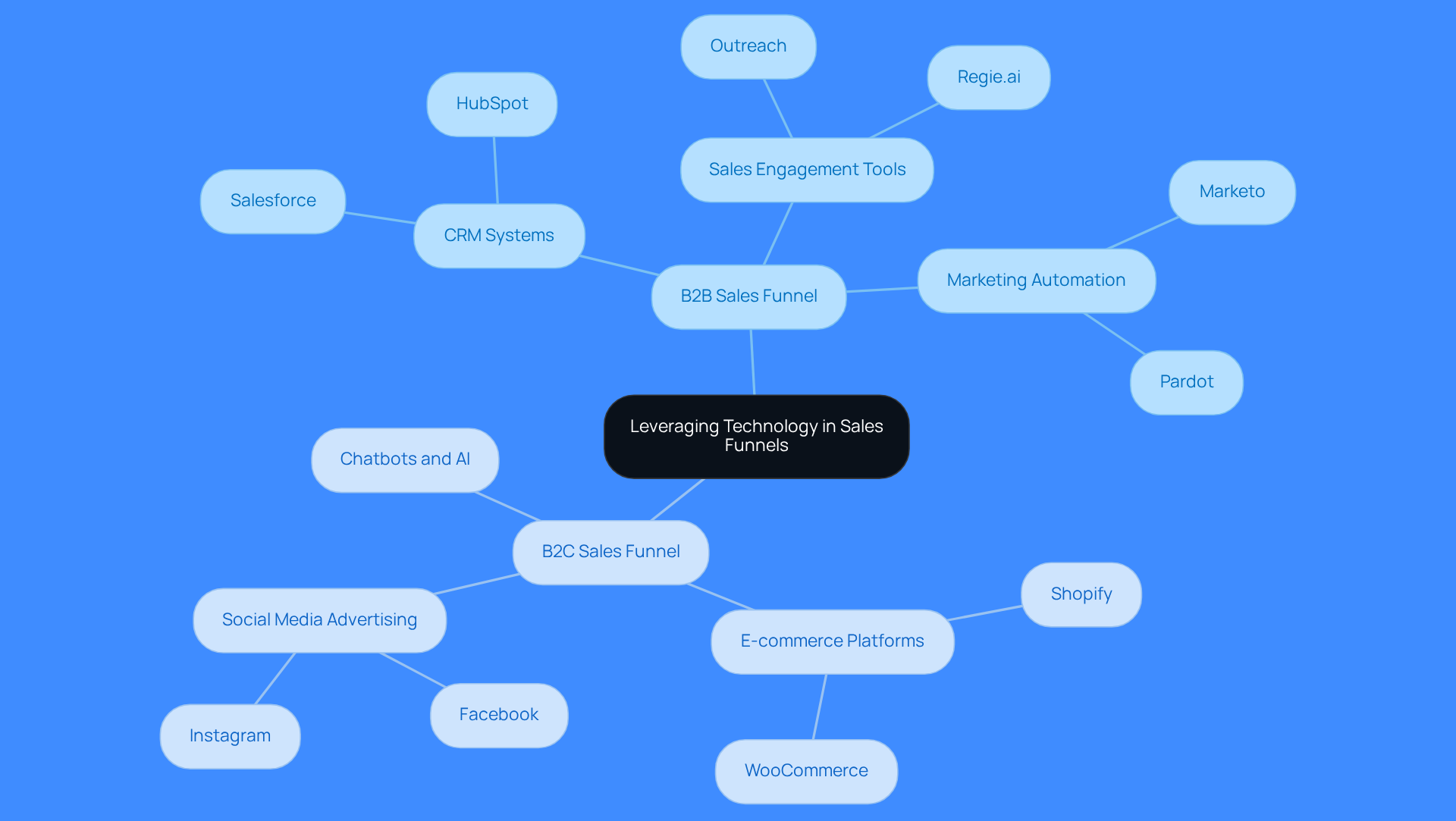
Operational inefficiencies hinder sales effectiveness in the sales funnel B2B. Technology is essential for automating repetitive tasks and improving engagement. Key tools include:
- CRM Systems: Platforms like Salesforce and HubSpot are pivotal in managing customer relationships, tracking interactions, and analyzing data to inform sales strategies. Companies leveraging Salesforce's CRM foster collaboration among 9 to 13 stakeholders, which is crucial for effective decision-making.
- Sales Engagement Tools: Solutions like Regie.ai enhance outreach efforts, automate follow-ups, and offer analytics to improve sales strategies. Regie.ai's AI Agents dynamically adjust outreach based on engagement, persona, and intent signals, ensuring that teams connect with prospects in a personalized manner. Regie.ai consolidates commercial tools into one platform, enhancing operations and the buyer experience. Additionally, Regie.ai has been recognized as a G2 Momentum Leader, Grid Leader, and Most Implementable Mid-Market, showcasing its market position and credibility.
- Marketing Automation: Tools such as Marketo and Pardot facilitate targeted campaigns that cultivate leads through the process, ensuring timely and relevant communication. In 2026, successful content strategies will involve teaching with real examples and addressing frequent inquiries from sales groups, further improving lead interaction.
For B2C sales funnels, technology also plays a significant role in enhancing efficiency and customer experience:
- E-commerce Platforms: Solutions like Shopify and WooCommerce facilitate seamless online transactions and provide insights into consumer behavior, driving conversion rates.
- Social Media Advertising: Platforms such as Facebook and Instagram enable targeted advertising that connects with potential customers based on their interests and behaviors, significantly boosting interaction.
- Chatbots and AI: Implementing chatbots on websites can provide instant support and guide consumers through their purchasing journey, improving engagement and conversion rates.
Using these technologies, especially Regie.ai, B2B and B2C sales teams can enhance their sales funnel B2B and streamline processes for better results. Embracing these technologies is not just an option; it's essential for staying competitive in today's market.
Conclusion
B2B sales often stall due to lengthy decision-making processes and the involvement of multiple stakeholders, making a tailored approach essential. B2B requires relationship-building through multiple touchpoints, while B2C focuses on quick, easy purchases. This understanding enables teams to tailor their outreach, improving engagement and conversion rates.
- Personalization is key in B2B, while B2C thrives on speed and ease of purchase, highlighting the need for distinct strategies.
- Using Regie.ai enhances outreach with AI-driven insights, adapting strategies based on engagement signals to boost conversion rates.
- Operational efficiency and customer engagement are critical; organizations must adopt best practices for both B2B and B2C sales funnels.
- Integrating advanced technologies and personalized strategies is essential for meeting customer expectations effectively.
- Integrating advanced technologies and personalized strategies is not just beneficial; it’s essential for maintaining a competitive edge in today’s market.
Frequently Asked Questions
What are the main differences between B2B and B2C sales funnels?
B2B sales funnels involve lengthy transaction cycles and multiple decision-makers, while B2C sales funnels focus on individual consumers and can finalize transactions in days. B2B processes typically span 60 to 120 days, requiring organized follow-up to maintain momentum.
Why is understanding the B2B sales funnel important for sales teams?
Understanding the B2B sales funnel is essential for sales teams to tailor their strategies and messaging effectively, as the complexities of multiple stakeholders necessitate varied approaches to managing customer relationships and improving conversion rates.
How long does the average B2B transaction cycle take?
The average B2B transaction cycle spans 60 to 120 days.
What percentage of B2B transactions occur in digital channels?
80% of B2B transactions occur in digital channels.
How important is prompt follow-up in B2B sales?
Prompt follow-up is crucial in B2B sales; responding to leads within 5 minutes makes prospects 9 times more likely to convert.
How can Regie.ai enhance outreach efficiency in B2B sales?
Regie.ai utilizes AI-driven signals and an integrated parallel dialing feature to enhance outreach efficiency, allowing representatives to connect with leads at the right moment with the appropriate message.
List of Sources
- Define B2B and B2C Sales Funnels: Core Concepts and Structures
- Types of sales funnels: your 2026 guide - wearebeyondgreatness.co.uk (https://wearebeyondgreatness.co.uk/types-of-sales-funnels-your-2026-guide)
- What Is a B2B Marketing Funnel? Stages & Tactics (https://salesforce.com/marketing/b2b-automation/b2b-marketing-guide/b2b-marketing-funnel)
- B2B Sales Funnel Stages: 2026 Guide with Benchmarks- SPOTIO (https://spotio.com/blog/b2b-sales-funnels)
- Understanding the B2B Sales Funnel (https://saleshive.com/blog/understanding-the-b2b-sales-funnel)
- B2C Sales Funnel Guide in 2025 - DeadlineFunnel (https://deadlinefunnel.com/blog/b2c-sales-funnel)
- Compare Stages of B2B and B2C Sales Funnels: Awareness to Conversion
- B2B Buying Behavior in 2026: 57 Stats and Five Hard Truths That Sales Can’t Ignore (https://corporatevisions.com/blog/b2b-buying-behavior-statistics-trends)
- B2B Sales Funnel vs B2C Sales Funnel: 4 Fundamental Differences (https://thesalesblog.com/blog/b2b-sales-funnel)
- B2B Sales Funnel Stages: 2026 Guide with Benchmarks- SPOTIO (https://spotio.com/blog/b2b-sales-funnels)
- B2B vs. B2C Sales Funnel: Key Differences and Optimisation Strategies (https://bettercommerce.io/blog/b2b-vs-b2c-sales-funnel-the-key-differences)
- B2B Sales Funnel: Stages, Strategy, and Optimization Guide 2026 (https://intentamplify.com/blog/all-that-you-should-know-about-the-b2b-sales-funnel)
- Implement Best Practices for B2B and B2C Sales Funnels: Strategies for Success
- 45 Sales Statistics Every Team Should Know in 2026 (https://flowlu.com/blog/productivity/sales-statistics)
- Building a B2B Sales Funnel in 2026 (https://leadfeeder.com/blog/marketing-strategy/b2b-sales-funnel)
- B2C Sales Funnel Guide in 2025 - DeadlineFunnel (https://deadlinefunnel.com/blog/b2c-sales-funnel)
- 🕵🏻♂️ The 2026 B2B content playbook. (https://fullfunnel.substack.com/p/the-2026-b2b-content-playbook)
- 2026 Strategies for Your B2B Sales and Marketing Funnel (https://thelakehousedigital.com/b2b-sales-and-marketing-funnel)
- Leverage Technology in B2B and B2C Sales Funnels: Tools and Automation
- EndeavorB2B | (https://endeavorb2b.com/blog/2026-b2b-marketing-trends)
- B2B Marketing Trends for 2026 | RED66 Marketing (https://red66marketing.com/blog/b2b-marketing-trends-2026)
- The State of B2B Marketing: Trends and Insights In 2026 - Demand Gen Report (https://demandgenreport.com/resources/the-state-of-b2b-marketing-trends-and-insights-in-2026/52008)
- 7 Best B2B Sales Tools and Software for 2026 (https://salesforce.com/sales/b2b-sales-tools)
- 15 Essential B2B Sales Software Tools for 2026 Success (https://regie.ai/blog/15-essential-b2b-sales-software-tools-for-2026-success)
FAQs
Read more posts
View all Blogs
Need more help?
If you still have questions, make sure to check out our Help Center: there, you'll find all the tips & advice you'll need to get your team up & running with Regie.ai.