Maximize Sales Efficiency with AI in CRM: Best Practices for Leaders

Introduction
Sales teams today face a significant challenge: they're overwhelmed by repetitive tasks and fragmented technology. This operational friction hampers efficiency and revenue potential. Integrating artificial intelligence (AI) into customer relationship management (CRM) systems addresses this issue head-on. By automating routine processes and delivering actionable insights into customer behavior, AI enables organizations to boost sales efficiency and drive revenue growth.
However, the real question is: how can leaders implement AI strategies effectively? It’s not just about streamlining workflows; it’s about fostering a culture of continuous learning and adaptation within teams. Embracing AI as a smarter infrastructure shift, rather than merely another tool, can lead to substantial improvements in pipeline performance and operational efficiency.
Understand the Role of AI in CRM Systems
Modern CRM systems face significant operational challenges, particularly with repetitive tasks and fragmented tech stacks. These inefficiencies hinder sales teams, forcing them to spend valuable time on data entry, lead scoring, and other low-value activities.
AI solutions address these pain points by automating routine tasks and analyzing customer data to deliver actionable insights. This strategic shift allows teams to focus on core activities, enhancing productivity and enabling communications that resonate with potential buyers.
By leveraging machine learning algorithms, AI accurately predicts customer behavior, facilitating targeted interactions that improve transaction effectiveness. This approach not only boosts sales but also enhances customer satisfaction through timely and relevant engagement.
Organizations that have integrated AI systems report substantial improvements, with studies showing revenue increasing by up to 30% due to better targeting and personalization. As we approach 2026, the role of AI will continue to expand, driving further enhancements in revenue performance and operational efficiency.

Select AI Tools That Integrate Seamlessly with Your CRM
Selecting tools that utilize AI in CRM requires a focus on functionality. Platforms like Regie.ai stand out with robust APIs and strong data synchronization support, ensuring smooth information flow between systems. This capability enhances productivity, allowing teams to focus on selling rather than getting bogged down by administrative tasks. By automating routine work, Regie.ai enables teams to engage with 3-5 times more accounts through efficiencies that manual efforts simply can't match.
Scalability is another important factor; the tools must evolve with your business needs. Conducting thorough research and pilot testing is essential to evaluate how well these tools integrate with your existing CRM setup. This proactive approach minimizes disruptions and enhances overall performance.

Train Your Sales Team to Leverage AI Effectively
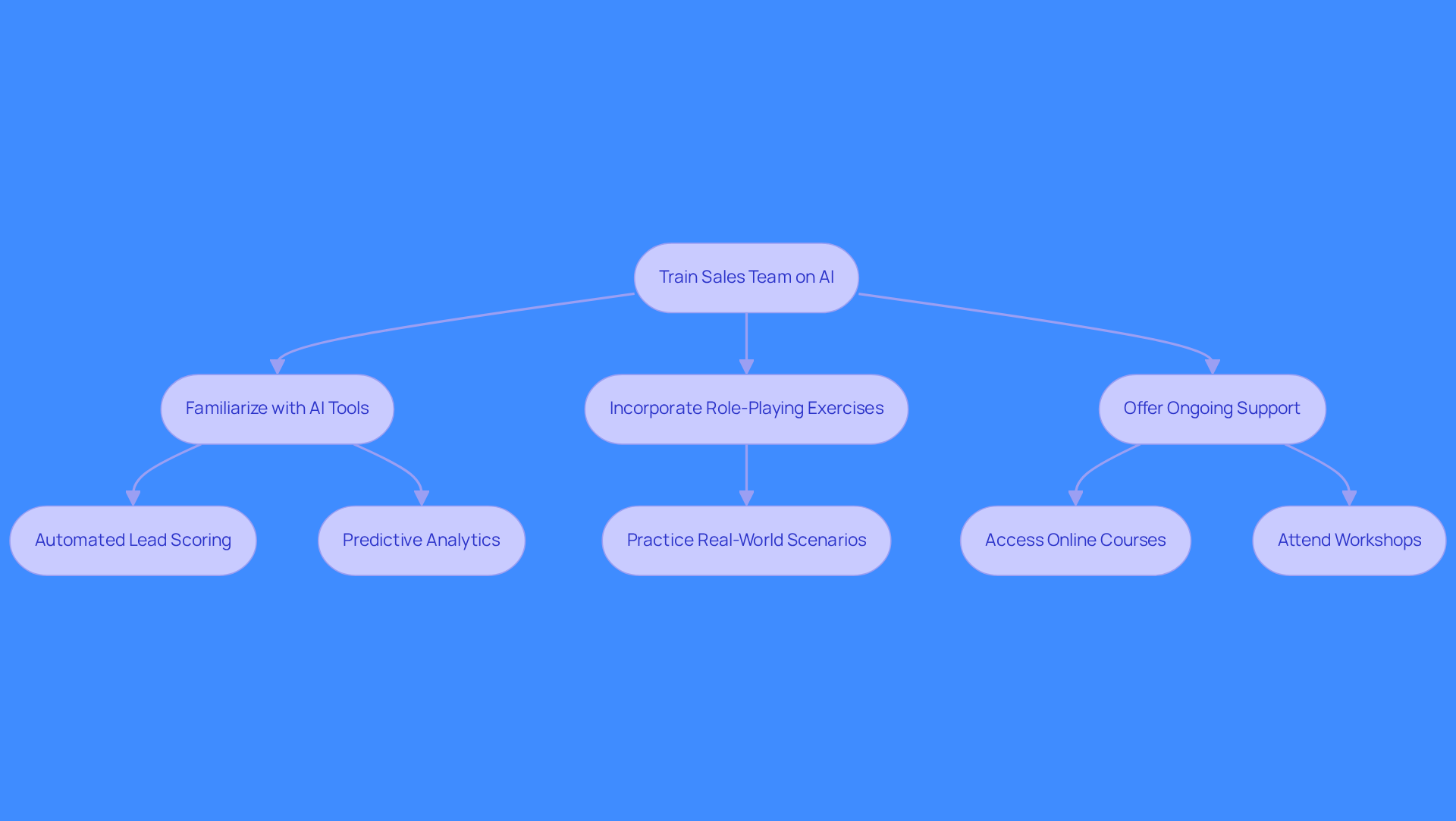
To effectively leverage AI, it is crucial to train your sales team. Begin by familiarizing them with AI tool features like predictive analytics, which can significantly enhance decision-making.
Incorporate role-playing exercises that mimic real-world marketing scenarios, enabling team members to practice integrating AI insights into their presentations.
Additionally, offer resources, such as access to online courses and workshops, to keep your team updated on the latest AI advancements.
By investing in training, you empower your team to utilize AI effectively, resulting in improved performance and increased conversion rates.
Implement Dynamic Workflows for Personalized Sales Outreach
Workflows are essential for personalizing marketing efforts and improving engagement rates. By leveraging AI tools to analyze customer data and behavior, businesses can customize their messaging and timing to fit individual preferences. For example, Regie.ai's platform offers features that adjust based on lead interactions, ensuring communication is relevant and timely.
Implementing triggers that initiate specific actions - like sending a follow-up email or scheduling a call - when a lead engages with your content can greatly enhance the sales process. This method encourages a more personalized approach and boosts the chances of conversion, as prospects receive communications that directly address their needs and interests.
The impact of such strategies is evident, with Regie.ai achieving a notable 48% increase in conversions through its automation and customized outreach powered by AI. Furthermore, incorporating human review in AI-generated content is crucial to avoid generic messaging and maintain authenticity, as highlighted by user testimonials who value the platform's ability to cohesively connect valuable information.
Overall, the use of AI tools reportedly increases reply rates from industry averages of 0.5-2% to as high as 6-20%, according to industry experts.
Measure and Optimize AI Impact on Sales Performance
To drive revenue performance through AI, establishing clear metrics and KPIs is essential. Focus on key indicators like:
on AI tool usage and its impact on revenue. Regularly reviewing this data uncovers improvement areas, allowing for the optimization of sales strategies. For example, if certain outreach methods yield higher engagement, reallocating resources to these approaches can significantly boost results. By consistently measuring and refining AI's impact, you can improve sales processes and enhance the return on your AI investments.

Conclusion
Integrating AI into CRM systems addresses a critical operational pain in modern outbound sales. Many organizations struggle with fragmented tech stacks and outdated workflows that hinder efficiency. By automating routine tasks and providing actionable insights, AI allows sales teams to concentrate on high-value activities, ultimately enhancing conversion rates and customer satisfaction.
To maximize the benefits of AI in CRM, organizations should:
- Select tools that integrate seamlessly with existing systems
- Invest in thorough training for sales teams
- Implement dynamic workflows for personalized outreach
These strategies not only streamline operations but also create tailored customer experiences that resonate with prospects, driving significant revenue growth.
As the sales landscape evolves, leveraging AI in CRM is essential. By committing to these practices, businesses position themselves at the forefront of innovation, effectively meeting customer needs and capitalizing on emerging opportunities. Embracing AI is not merely a trend; it is a vital strategy for sustainable success in today’s competitive market.
Frequently Asked Questions
What challenges do modern CRM systems face?
Modern CRM systems encounter operational challenges such as repetitive tasks and fragmented tech stacks, which hinder sales teams by forcing them to spend time on data entry, lead scoring, and customer segmentation instead of high-value activities.
How does AI improve CRM systems?
AI enhances CRM systems by automating routine tasks and analyzing customer data to provide actionable insights, allowing teams to streamline workflows, increase productivity, and develop personalized outreach strategies.
What benefits does AI bring to customer interactions?
By leveraging machine learning algorithms, AI predicts customer behavior, facilitating targeted interactions that improve transaction effectiveness, boost conversion rates, and enhance customer satisfaction through timely and relevant engagement.
What impact does AI integration in CRM have on revenue?
Organizations that integrate AI in their CRM systems report significant revenue improvements, with studies indicating conversion rates can increase by up to 30% due to better targeting and personalization.
What should be considered when selecting AI tools for CRM?
When selecting AI tools for CRM, it is important to focus on seamless integration capabilities, scalability to evolve with business needs, and to conduct thorough research and pilot testing to ensure compatibility with existing CRM setups.
Can you give an example of an AI tool that integrates well with CRM?
Regie.ai is an example of an AI tool that integrates seamlessly with CRM systems, offering robust APIs and strong data synchronization support, which enhances CRM functionality by automating lead generation and follow-up.
What is the expected trend for AI in CRM by 2026?
By 2026, the role of AI in CRM is expected to expand further, driving enhancements in revenue performance and operational efficiency.
List of Sources
- Understand the Role of AI in CRM Systems
- cio.com (https://cio.com/article/4109560/how-ai-powered-crm-meets-rising-customer-expectations-with-proactive-service.html)
- reuters.com (https://reuters.com/plus/raising-your-profile-worldwide/the-future-of-crm-whats-changing-and-why-it-matters)
- 2026 CRM Outlook: AI, Humans, and Scale Converge (https://crmbuyer.com/story/2026-crm-outlook-ai-humans-and-scale-converge-177583.html)
- cirrusinsight.com (https://cirrusinsight.com/blog/ai-crm)
- AI Agents Take Center Stage – Will Sales Teams That Automate Win in 2026? (https://futurumgroup.com/insights/ai-agents-take-center-stage-will-sales-teams-that-automate-win-in-2026)
- Select AI Tools That Integrate Seamlessly with Your CRM
- 12 AI tools every sales team needs in 2026 | Glenn Poulos (https://linkedin.com/posts/glennpoulos_12-ai-tools-every-sales-team-needs-in-2026-activity-7401976535995355136-3NsB)
- emailvendorselection.com (https://emailvendorselection.com/best-ai-crm)
- seamless.ai (https://seamless.ai/news/releases/api)
- sybill.ai (https://sybill.ai/blogs/ai-sales-tools)
- dev.to (https://dev.to/lightningdev123/best-ai-driven-crm-for-automating-your-sales-in-2026-1fh1)
- Train Your Sales Team to Leverage AI Effectively
- highspot.com (https://highspot.com/blog/hit-sales-quota-with-ai-coaching)
- barrettmedia.com (https://barrettmedia.com/2026/03/09/crs-2026-announces-ai-talent-development-sales-training-workshop)
- saastr.com (https://saastr.com/the-2026-sales-team-50-humans-50-ais-all-1-team)
- salesandmarketing.com (https://salesandmarketing.com/the-state-of-sales-in-2026-ai-raises-the-bar-but-people-still-win)
- techsommet.com (https://techsommet.com/why-sales-team-needs-ai-in-2026)
- Implement Dynamic Workflows for Personalized Sales Outreach
- outreach.io (https://outreach.io/resources/blog/february-2026-product-release)
- instantly.ai (https://instantly.ai/blog/how-to-use-ai-for-sales-outreach-personalization)
- pymnts.com (https://pymnts.com/earnings/2026/target-eyes-ai-sales-momentum-through-personalization)
- cybernews.com (https://cybernews.com/ai-tools/best-ai-tools-for-outreach)
- AI Agents Take Center Stage – Will Sales Teams That Automate Win in 2026? (https://futurumgroup.com/insights/ai-agents-take-center-stage-will-sales-teams-that-automate-win-in-2026)
- Measure and Optimize AI Impact on Sales Performance
- forbes.com (https://forbes.com/sites/terdawn-deboe/2025/11/26/the-2026-ai-decision-why-measurement-matters-more-than-adoption)
- parcelandpostaltechnologyinternational.com (https://parcelandpostaltechnologyinternational.com/news/technology/ai-adoption-to-boost-sales-and-enhance-delivery-performance-in-2026-new-report-reveals.html)
- bain.com (https://bain.com/insights/ai-transforming-productivity-sales-remains-new-frontier-technology-report-2025)
- eubrics.com (https://eubrics.com/blog/sales-performance-metrics-kpi)
FAQs
Read more posts
View all Blogs

Need more help?
If you still have questions, make sure to check out our Help Center: there, you'll find all the tips & advice you'll need to get your team up & running with Regie.ai.